
玉观音
小白保姆级教程:不用写代码在阿里云分钟级一键部署OpenClaw,打造你的专属 AI 员工_我的网站

A | Exactly 75 years ago Jawaharlal Nehru, one of the principal leaders of India’s independence movement in the 1930s and 1940s, was sworn in as prime minister of the Dominion of India and raised the national flag at the Red Fort in Delhi. Having brought an end to the colonial rule of the British Empire, the Indian leadership embraced the concept of "non-alignment" and "neutrality" and diversified its ties, seeking new partnerships. At the time, the Soviet Union emerged as a natural ally for the independent Indian state.,Nehru was attracted to Marxism and promoted the idea of evolutionary and inclusive socialism. Back in 1927, the would-be Indian prime minister visited the USSR for the first time together with his wife Kamala, younger sister Krishna, and his father Motilal Nehru, a leader of the Indian National Congress.,The trip was connected with the 10th Anniversary of the Great October Socialist Revolution, which was seen by Nehru and other Indian nationalists in "a very positive light," according to Dr. Anuradha Chenoy, professor of the Center for Russian and Central Asian Studies at Jawaharlal Nehru University.,The Soviet press extensively covered the Nehrus' visit to Moscow, hailing Motilal and Jawaharlal as prominent leaders of India’s freedom movement. Jawaharlal Nehru was received in the Kremlin by Mikhail Kalinin, chairman of the Central Executive Committee of the USSR. Having wrapped up his journey, the Indian politician wrote a booklet titled "Soviet Russia, some random sketches and impressions" (1928).,"Jawaharlal Nehru was influenced by Marxist and socialist thought to some extent, as he saw the need for state intervention for alleviating poverty, developing infrastructure and for development," says Dr. Chenoy. "He thus advocated and made policies to develop state- or public sector industries and also created a Planning Commission. Independent India's Second Plan was especially modeled around the Soviet planning system.",CC BY 2.0 / Public.Resource.Org / Photo 656 Pandit Jawaharlal Nehru at the mike. 20.7.47 Pandit Jawaharlal Nehru at the mike. 20.7.47 CC BY 2.0 / Public.Resource.Org / Photo 656,USSR Helped India Lay the Groundwork for Industrialization,On January 26, 1950, India became a republic within the Commonwealth of Nations with Jawaharlal Nehru serving as the Republic of India's prime minister until May 27, 1964. During this period, the USSR and India started to deepen their ties, according to Dr. Chenoy.,"Soviet support was crucial for an underdeveloped and newly liberated country like India," the academic explains. "Since India wanted to develop as a 'mixed economy,' that is to have both a state and private sector, Western countries refused them any aid and assistance that India needed. So India turned to the Soviet Union. The Soviet Union assisted India in the creation of new steel plants and several infrastructure industries. They assisted in developing Indian science and technology institutions which laid the base for Indian development in later years.",Dr. Chenoy elaborates that in the 1950s, the USSR helped India lay the groundwork for the country's early industrialization, with the Asian giant then starting to receive Russian defense equipment and military hardware.,CC0 / / Indian Prime Minister Indira Gandhi (1917-1984) at the National Press Club, Washington, D.C. 1n 1966 Indian Prime Minister Indira Gandhi (1917-1984) at the National Press Club, Washington, D.C. 1n 1966CC0 / /,Indo-Soviet Treaty of Peace, Friendship and Cooperation,The Indian war with Pakistan in 1971 became a pivotal moment for Indo-Soviet relations, according to the Indian academic. The conflict erupted over the Bangladesh liberation movement in East Pakistan, which was accompanied by killings of the Bengalis – both Muslims and Hindus – by West Pakistani forces led by General Agha Muhammad Yahya Khan in March 1971.,As a result of the violence and instability caused by the onslaught in East Pakistan, an estimated 10 million Bengalis fled to India by May 1971, prompting Delhi to intervene. Judging from documents released in December 2002 by the National Security Archive (NSA), a US non-profit archival institution, US President Richard Nixon and National Security Advisor Henry Kissinger did nothing to curtail the West Pakistani repressions against Bengalis and backed General Yahya.,After India stepped in to shield the Bengalis, "not only did the United States publicly pronounce India as the aggressor in the war, but the US sent the nuclear aircraft carrier, USS Enterprise, to the Bay of Bengal, and authorized the transfer of US military supplies to Pakistan, despite the apparent illegality of doing so," according to the non-profit.,Moscow's help came in handy at the time: in August 1971, India and the USSR concluded the Indo-Soviet Treaty of Peace, Friendship and Cooperation that specified mutual strategic cooperation between the countries. The treaty sent a powerful signal to the US and its allies. Eventually, the conflict ended on December 16, 1971 with the military forces of West Pakistan that were in Bangladesh surrendering.,"The Indian war with Pakistan on the issue of the liberation of Bangladesh in 1971 was a very special moment of Soviet support since the US wanted to help its ally Pakistan," says Dr. Chenoy. "After this, the Treaty of Friendship signed between India and the USSR was very holistic and provided India with much technological and defense support. Since then the friendship has increased.",© Photo : Indian PM OfficeModi Putin MeetModi Putin Meet© Photo : Indian PM Office,India's Strategic Autonomy,The historic Indo-Soviet Treaty of Peace, Friendship and Cooperation was renewed for another 20 years on August 8, 1991. After the collapse of the USSR, Moscow and New Delhi replaced the accords with the 20-year Treaty of Indo-Russian Friendship and Cooperation in January 1993.,Although the dissolution of the USSR resulted in a temporary chill in Russo-Indian economic and trade relations, they were soon reshuffled and are continuing to develop regardless of sanctions imposed by the West, according to Dr. Chenoy.,Since the declaration of independence back in 1947, India has managed to achieve significant strategic autonomy. The country has been maintaining ties with various global powers in accordance with its own strategic plans.,Thus, in June 2022, Indian Foreign Minister Subrahmanyam Jaishankar made it clear at the GlobeSec 2022 Bratislava Forum that India would not copycat the West's anti-Russia policies in the wake of Moscow's special operation to demilitarize and de-Nazify Ukraine. He stressed that “the world cannot be that Euro-centric as it used to be in the past,” adding that India, which is one-fifth of the world’s population and the fifth-largest economy will be guided by its national interests in the first place.。
阿里云优惠券 先领券再下单 2026年,AI智能体(Agent)的发展已从单纯的“聊天互动”迈向“实干落地”。

B | 其中,OpenClaw在GitHub上迅速崛起,成为炙手可热的“顶流”项目。它凭借卓越的自动化能力,正逐渐成为众多用户不可或缺的“第二大脑”。然而,其复杂的本地部署环境常常让新手望而却步。 别焦虑!现在,依托阿里云计算巢与轻量应用服务器强大的“一键部署”功能,即便是零基础的用户,也能在短短10分钟内,轻松拥有一个专属的AI员工。

C | 接下来,本教程将手把手带你走完从部署、配置到验证的全流程。 01 准备阶段:必备三要素 在正式开启部署之旅前,请务必提前准备好以下三样“入场券”: 阿里云账号:需完成实名认证,个人或企业账号均可。 API Key:这是赋予AI智能体“智慧大脑”的关键。推荐使用阿里云百炼(通义千问)或MiniMax的API Key,不仅国内访问稳定,而且成本合理可控。 服务器预算:轻量应用服务器最低配置(2核2G)月付约30-50元,建议选择中国香港或新加坡地域,无需备案且支持完整联网功能。 02 核心部署:5分钟一键搞定 阿里云针对OpenClaw提供了两种“开箱即用”的部署方案,全程可视化操作,无需敲代码。

D | 方案A:轻量应用服务器(推荐新手) 这是最快捷的部署方式,适合个人用户。 步骤1:进入阿里云轻量应用服务器控制台,点击“创建实例”。 步骤2:在“应用镜像”中,选择 OpenClaw (Clawdbot) 镜像。系统已预装所有依赖,无需手动安装。 步骤3:选择地域(推荐海外),配置资源(2核2G起步)。

E | 步骤4:等待约1-2分钟,系统自动完成部署。在实例详情页的“应用管理”中,找到OpenClaw的访问地址和Token。 方案B:计算巢部署(适合企业) 计算巢方案支持更灵活的资源配置,适合企业级部署。 步骤1:进入阿里云计算巢服务控制台,搜索“OpenClaw社区版”。 步骤2:点击“立即部署”,填写服务实例名称。 步骤3:在“服务配置”中,填入你的API Key和自定义Token。 步骤4:确认订单,系统自动创建ECS实例并完成环境配置。
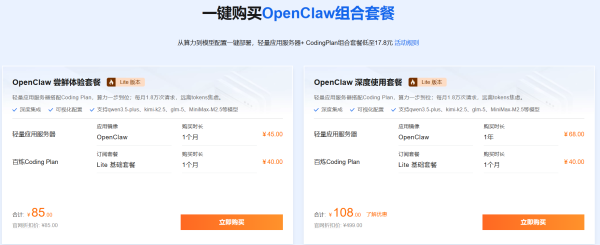 你只需要在阿里云官网活动页面购买OpenClaw组合套餐,然后一键部署即可: 官网购买地址:https://www.aliyun.com/activity/ecs/clawdbot?userCode=i4hlo7k3 03 关键配置:为 AI 注入“智慧灵魂” 完成部署后,接下来最为关键的一步便是绑定大模型 API Key。这一操作就好比给 AI 员工装上“聪明的大脑”,直接决定了它能否高效、准确地为你服务。 获取 API Key 登录阿里云百炼控制台,在控制台界面中找到“密钥管理”选项,点击进入后,按照提示创建新的 API Key,创建成功后,仔细复制该 Key,以备后续使用。

F | 配置环境变量 打开服务器终端,在终端中执行以下命令(以下示例以阿里云百炼为例): bash Copy Code # 配置环境变量(请将'你的API Key'替换为实际复制的 Key) export DASHSCOPE_API_KEY='你的API Key' # 使配置立即生效 source ~/.bashrc 验证配置 完成环境变量配置后,为了确保配置无误,执行以下命令进行验证: bash Copy Code echo $DASHSCOPE_API_KEY 若终端能够正常输出你刚刚配置的 API Key,那就说明配置成功,你的 AI 员工已经拥有了“智慧大脑”的基础支撑。 04 功能验证:检验 AI 员工的工作状态 配置工作完成后,接下来需要通过一系列测试来验证你的 OpenClaw 是否能够正常工作,就像对新入职的员工进行岗前培训考核一样。 Web 控制台登录 在浏览器的地址栏中输入 http://你的公网 IP:18789,回车后进入登录页面,输入预先设置好的 Token,即可成功登录 OpenClaw 的 Web 控制台,开启与 AI 员工的交互之旅。 基础对话测试 在 Web 控制台的对话框中,输入简单的问候语“你好”,然后耐心等待 AI 的回复。如果 AI 能够迅速且准确地给出回应,那就表明大模型已经成功连接,AI 员工具备了基本的语言交互能力。 技能测试 为了进一步检验 AI 员工的核心自动化功能,在对话框中输入指令“帮我打开百度首页”。如果 AI 能够自动操控浏览器,顺利打开百度首页,并将相关结果返回给你,那就说明它的核心自动化功能一切正常,可以承担更复杂的工作任务了。 05 实战场景:释放 AI 员工的“动手”潜能 你的 AI 员工已经通过各项考核,正式“上岗”了。

G | 现在,就可以充分发挥它的优势,让它去处理各种实际工作了。以下是几个高频使用场景,供你参考: 自动化办公 当你被堆积如山的邮件搞得焦头烂额时,只需向 AI 员工发出指令:“帮我清理收件箱,删除所有广告邮件,把重要邮件标记为已读。”它就会迅速行动起来,按照你的要求高效完成邮件清理工作,让你从此告别邮件杂乱的困扰。 信息搜集 在信息爆炸的时代,快速获取有价值的信息至关重要。你可以向 AI 员工下达指令:“帮我搜索 2026 年最新的 AI 行业报告,下载 PDF 并总结核心观点。

H | ”它会在浩如烟海的网络信息中精准筛选出你需要的报告,下载后还能为你提炼出核心观点,让你在短时间内掌握行业动态。 结语 通过阿里云的一键部署方案(点击购买)技术门槛被降至最低。现在,你不仅拥有了一个会聊天的AI,更拥有了一个能动手干活的“数字员工”。未来已来,只是分布尚不均匀——而你,已经站在了最前沿。

I |
申请创业报道,分享创业好点子。点击此处,共同探讨创业新机遇!。
Current article:http://shaimeihaoangguanwahuaisaiyao.buzz/news/20260826_1781178.html
Published on:01:27:09
 中国第16次北冰洋考察|“雪龙2”号开展冰站作业
 班凯罗谈附加赛不敌76人:我心态犹豫致发挥失常
 国际足联主席的脸 又被特朗普打了
 专利出海交易爆发,中国创新药成为“全球合伙人”
 Apple AirPower无线充电器出现在iPhone XS的智能电池盒页面上。
 雷军任命陆伟兵为红米品牌副总裁、总经理。